
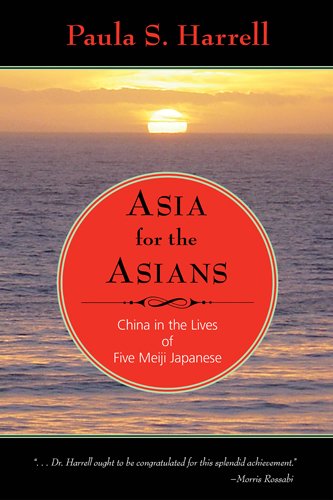
Asia for the Asians: China in the Lives of Five Meiji Japanese (Study of the Weatherhead East Asian I)
Product details
| Management number | 231661143 | Release Date | 2026/06/18 | List Price | US$14.00 | Model Number | 231661143 | ||
|---|---|---|---|---|---|---|---|---|---|
| Category | |||||||||
The current dispute between an expanding China and a newly assertive Japan over sovereign rights in the East China Sea will more likely continue as a standoff than escalate into an outright military conflict. But whatever the outcome, it opens an entirely new chapter in the competition for regional dominance that began a century and a half ago when China and Japan, challenged by a technologically superior West embarked on alternative paths to modernity. Asia for the Asians offers an analytical yet personal account of the secret to Japan's success in becoming the first Asian "Pacific power": a willingness to learn from experience elsewhere and to rework to new purpose its ties to China and Chinese tradition. The five public figures profiled in the book reflect this spirit of reinvention and the conviction that as a late developing nation Japan had useful lessons to offer the rest of Asia. By the late nineteenth-century, Chinese leaders agreed. For well over a decade, with Chinese concurrence and financing, many influential Japanese traveled to China to work on the very kinds of modernizing projects that have engaged outside experts working in China more recently. And they identified for public discussion issues that feel remarkably contemporary: the effectiveness of cultural diplomacy, the link between technology transfer and innovation, the prospects for a Pacific community, constitutional versus authoritarian governance, and the applicability of Western-inspired international law to non-Western settings. Asia for the Asians provides a much needed corrective to the popular view that relations between China and Japan have ever and always been confrontational. It is a must-read for those involved in writing the next chapter of the story. Above all, it makes clear that the re-shaping of Asia going on at present is part of an unfinished enterprise with China, Japan, and the West (read the U.S.) still the central players facing the same fateful choice: cooperation or conflict. Read more
Bestseller ranking
Japan




Customers who viewed this product also viewed
Jerseys


Correction of product information
If you notice any omissions or errors in the product information on this page, please use the correction request form below.
Correction Request Form